NEW YORK, NY, UNITED STATES, July 9, 2026 /EINPresswire.com/ — Every admissions office can tell you how many applicants it rejected last cycle. It cannot tell you how many qualified candidates it lost without ever rejecting them the candidates whose files were still moving through credential evaluation when another institution made them an offer, and they took it (or mentally got committed to it).
This is the cost of slow turnaround, and it is usually filed under a wrong heading. Credential evaluation is treated as a back-office function, a matter of throughput to be managed with extra staff in peak season. However, the time taken to assess a transcript, verify authenticity, recalculate a GPA on a comparable scale, and return a decision shapes who gets enrolled. This matters most in international admissions.
The international applicant pool is at once shrinking and more contested than it has been in years. New international enrollments in the US fell around 17% in fall 2025, the first such decline in four years, with graduate enrollments down about 12%. At the same time, institutions in the UK, Canada and Australia are competing aggressively for the same candidates. An international candidate is now rarely applying to one country alone, and is managing several offers, visa timelines and aid deadlines at once none of which can be put on hold while an evaluation runs its course.
How long does credential evaluation take?
The evaluation of a candidate’s academic credentials is often the longest and most important step in the admissions process. Universities either evaluate foreign credentials in-house or require the applicant to obtain a report from a third-party evaluator, and both add weeks after the application is submitted. In our internal testing, third-party evaluation vendors took anywhere from two to eight weeks to return. In-house evaluation removes the external queue but still draws on staff time, which in peak season competes with everything else on the desk.
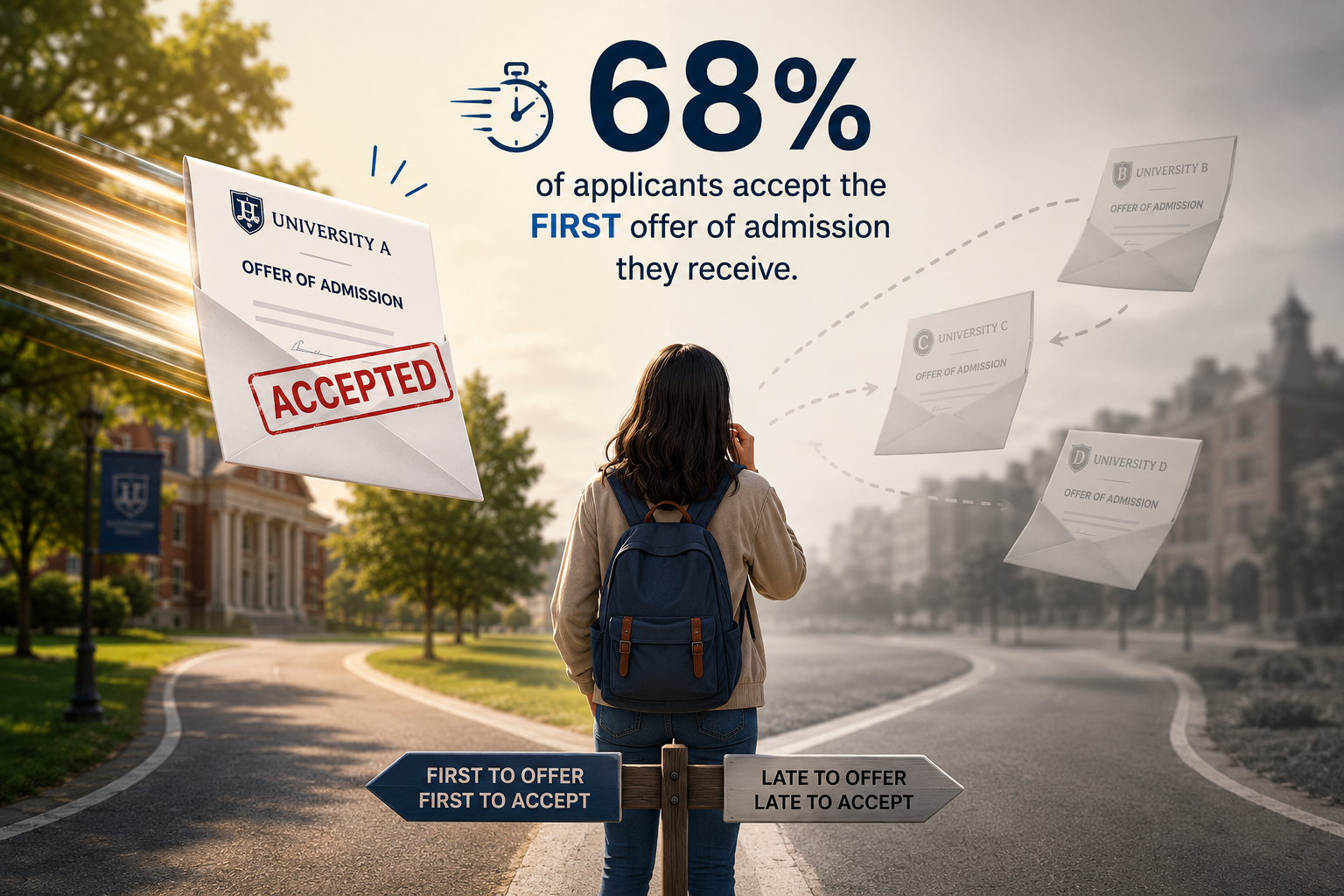
Does that delay cost the institution anything? A candidate weighing two offers often (all else roughly equal) moves with the one that arrives first; the window in which they decide is often a matter of days, and roughly 68% accept the first offer they receive. A slow evaluation is therefore, in many cases, not a delayed yes but a candidate who has already committed elsewhere by the time the yes is ready.
With published tuition averaging about $25,415 a year at a public university and well over $40,000 at a private one, a single master’s candidate represents some $40,000 to $60,000 over two years. A program admitting a few hundred international applicants annually, a loss rate of even a few percent then runs into the high six figures per cycle.
Transfer credit and GPA recalculation: the same clock, higher volume
Domestic transfer applicants face the same dynamic spread across far higher volume, and for them the wait has a particular edge. A transfer candidate is deciding on the strength of how much of their prior work will carry over and how their record converts onto the receiving institution’s GPA scale. Until the credit evaluation is done, they cannot see the one number that tells them whether the offer is worth taking. With around 38% of students transferring at least once before earning a bachelor’s degree, and transfer students losing an estimated 43% of their credits on average when they move (US Government Accountability Office), it is critical to get transfer evaluations done on priority.
How is credential evaluation changing in AI-Era?
The evaluation step is slow not mainly for want of effort, which is why adding staff in peak season helps so little, but because of how the work is built. It is manual and sequential: documents arrive in many languages and formats; grades sit on scales that must be recalculated; institutions must be checked for recognition, and each step waits on the one before it. This is an architecture built for a time of paper transcripts and scarce regional expertise — constraints that have been eroded away.
Structured data can now be extracted from transcripts across scripts and languages; foreign GPA conversion and grade normalization can be applied consistently from defined scales; institutional recognition can be checked against databases; and document tampering using advanced computer vision techniques can be detected at scale. The operational layer of evaluation is largely automatable. What remains for human judgment is the part that genuinely needs it: edge cases, departmental calibration and applying your own institution policies.
This is the shift worth acting on. Measured against the candidates it quietly loses, the time spent in evaluation is among the more expensive things an admissions office does, and among the few it rarely counts. This is the gap TruEnroll was built to close. The platform takes on the operational layer of credential evaluation document classification, extraction across 100+ languages, detailed accreditation lookup, GPA recalculations on default or institutional scales, real-time fraud detection using time-tested indicators and returns a structured, decision-ready evaluation in hours rather than weeks. It works whether an institution is bringing evaluation in-house for the first time or replacing an external provider, and it integrates with the systems admissions teams already run, so the result enters the existing workflow.
About Trential
New York-based technology company building secure digital infrastructure for credential management, verification, and evaluation, Trential’s vision is to reduce friction points in credential exchange globally. It is the largest provider of verification for nearly 60% of the foreign applications coming to the USA and Canada. Its newly launched AI-powered solution, TruEnroll, enables universities, admissions teams, and credential evaluation agencies to streamline their transcript processing operations at scale. Leveraging the company’s expertise in International Education Evaluation, TruEnroll is the #1 international application-processing platform, combining a high degree of accuracy with blazing-fast processing speeds. Natively available in Slate and Salesforce, and integrating seamlessly with Banner Recruit and Oracle PeopleSoft, TruEnroll is also the only transcript-processing platform in the market that is fully compliant with ISO 27001, ISO 27701, SOC 2 Type II, FERPA, GDPR, and CCPA, providing the highest level of data security transparency.
John Sherman
Trential
+1 646-866-9469
jsherman@trential.com
Level up your admissions process with AI-powered TruEnroll
Legal Disclaimer:
EIN Presswire provides this news content “as is” without warranty of any kind. We do not accept any responsibility or liability
for the accuracy, content, images, videos, licenses, completeness, legality, or reliability of the information contained in this
article. If you have any complaints or copyright issues related to this article, kindly contact the author above.

Media gallery