Global Dairy Enzymes Market to Hit USD 8.94 Billion by 2035 on Rising Lactose-Free Demand and Precision Fermentation
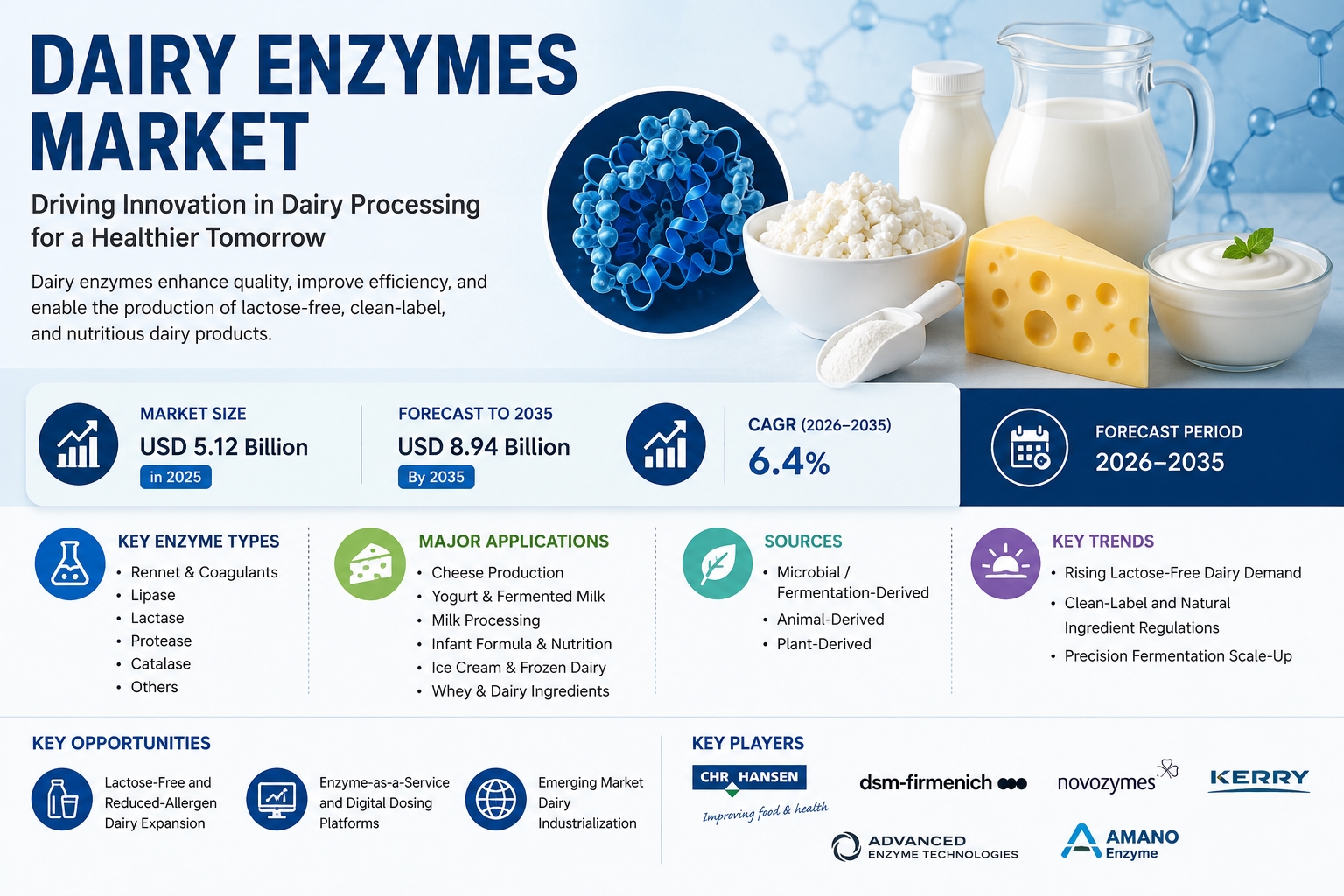
NEW YORK, NY, UNITED STATES, July 9, 2026 /EINPresswire.com/ — The global dairy enzymes market is entering a strong growth phase as manufacturers, ingredient suppliers, and dairy processors accelerate the use of enzyme technologies to improve product quality, enhance processing efficiency, and support healthier product formulations. According to the market outlook covered in the latest research, the dairy enzymes market was valued at USD 5.12 billion in 2025 and is projected to reach USD 8.94 billion by 2035, expanding at a CAGR of 6.4% during the forecast period 2026–2035.
The steady rise in lactose-free and reduced-allergen dairy demand, the growing use of clean-label and naturally derived ingredients, and the ongoing scale-up of precision fermentation are reshaping the dairy processing landscape. Enzymes are increasingly being used not only as functional processing aids, but also as strategic formulation tools that help manufacturers respond to evolving consumer preferences, regulatory expectations, and operational cost pressures.
Dairy enzymes play a central role in cheese production, yogurt and fermented milk processing, milk modification, infant nutrition, ice cream, whey processing, and other dairy ingredient applications. As global dairy companies and regional processors continue to innovate around texture, flavor, digestibility, and shelf life, enzyme adoption is expected to deepen across both mainstream and specialty dairy categories.
The market is also being supported by a broader shift toward premiumization in dairy. Consumers are seeking products that are easier to digest, more natural, and better aligned with wellness-focused lifestyles. This is creating new opportunities for lactase, protease, lipase, rennet and coagulant solutions, along with emerging technologies in microbial fermentation and plant-based enzyme sourcing.
Get Full PDF Sample Copy of Report: (Including Full TOC, List of Tables & Figures, Chart) @ https://www.marketresearchfuture.com/sample_request/5146
Rising Lactose-Free Demand Becomes a Major Growth Catalyst
One of the most important drivers of the dairy enzymes market is the continued rise in lactose-free dairy consumption. Across mature and developing markets alike, consumers are increasingly looking for products that reduce digestive discomfort while preserving the taste, convenience, and nutritional value of traditional dairy.
Lactase remains one of the most important enzymes in this segment because it breaks down lactose into simpler sugars, making milk, yogurt, and other dairy products more accessible to lactose-intolerant consumers. As dairy brands expand lactose-free product portfolios, demand for enzyme solutions continues to rise across retail and foodservice channels.
At the same time, reduced-allergen and digestive-health positioning is becoming more prominent in product development. Manufacturers are using enzymes to create milder, more digestible, and more consumer-friendly dairy products without relying on artificial additives. This trend is especially visible in premium milk, cultured dairy, ready-to-drink dairy beverages, and functional nutrition applications.
Clean-Label and Natural Ingredient Regulations Are Shaping Innovation
Another major trend influencing the dairy enzymes market is the expanding emphasis on clean-label and natural ingredient compliance. Consumers are paying closer attention to ingredient lists and processing methods, while regulators and retailers are placing greater scrutiny on product claims, transparency, and sourcing.
This shift is increasing the appeal of enzyme-based processing because enzymes can often deliver performance improvements without the need for chemical-heavy or highly processed alternatives. In cheese production, for example, enzyme systems can support coagulation, yield, and texture outcomes while helping brands maintain simpler ingredient statements. In milk and fermented dairy applications, enzymes can improve product functionality in ways that align with consumer expectations for more natural foods.
The clean-label trend is also encouraging dairy processors to improve sourcing transparency. Microbial and fermentation-derived enzymes are gaining traction due to their scalability, consistency, and compatibility with evolving sustainability goals. Plant-derived enzyme options are also attracting attention in niche applications, particularly where manufacturers are pursuing ethical, religious, or vegetarian positioning.
Precision Fermentation Is Creating New Competitive Possibilities
Precision fermentation is emerging as an important opportunity area for the dairy enzymes market. As biotechnology platforms become more capable and cost-effective, enzyme manufacturers are exploring ways to produce highly targeted, high-purity solutions with consistent performance characteristics.
This is particularly valuable in dairy processing, where exact enzyme activity can affect taste, texture, yield, and shelf life. Precision fermentation enables the production of enzymes with improved reliability and potentially reduced dependence on traditional supply chains. It also supports the development of next-generation dairy ingredients that can meet new consumer and industrial requirements.
The scale-up of this technology could be especially meaningful for companies seeking to balance food innovation with manufacturing efficiency. Over the forecast period, precision fermentation may also support faster product development cycles, more customized enzyme formulations, and greater flexibility for regional manufacturing strategies.
Enzyme Applications Continue to Expand Across Dairy Categories
Cheese production remains one of the largest and most established application areas for dairy enzymes. Rennet and coagulants are essential for curd formation and structure development, while lipase and protease enzymes are used to shape flavor profiles, maturation behavior, and overall product quality. As global cheese consumption expands, enzyme demand continues to benefit from both industrial-scale and artisanal production trends.
Yogurt and fermented milk products represent another important growth area. These categories are increasingly influenced by consumer demand for probiotic, high-protein, low-sugar, and digestively friendly dairy options. Enzymes support a variety of processing objectives in this segment, including improved texture, enhanced mouthfeel, and better control over fermentation outcomes.
Milk processing is also an important use case, especially where manufacturers are creating lactose-free milk, extended shelf-life products, and value-added fortified beverages. In infant formula and nutrition, enzymes contribute to product consistency, digestibility, and protein modification, making them valuable in a highly regulated and quality-sensitive category.
Ice cream and frozen dairy products use enzymes to improve texture, reduce crystallization issues, and enhance sensory performance. Meanwhile, whey and dairy ingredient manufacturers are increasingly using enzyme technologies to improve separation, functional performance, and downstream usability in food, beverage, and nutritional formulations.
Source Shift Toward Microbial and Fermentation-Derived Enzymes
The dairy enzymes market is undergoing a notable source shift, with microbial and fermentation-derived enzymes gaining a larger share of industry attention. These enzymes are valued for their scalability, purity, reproducibility, and suitability for a range of industrial applications.
Animal-derived enzymes continue to be used in important dairy segments, particularly in traditional cheese production. However, the market is gradually diversifying as manufacturers seek alternative sources that align better with vegan, vegetarian, religious, and sustainability-related purchasing preferences.
Plant-derived enzymes are also becoming more relevant in select applications, especially where consumers or brands prioritize non-animal inputs. While plant-based sources may not replace all conventional enzyme categories, they are helping diversify the market and create differentiated product offerings.
As manufacturers pursue more resilient supply chains, source flexibility is becoming a commercial advantage. Companies capable of offering enzyme systems across multiple source categories are likely to strengthen their position with multinational dairy producers and ingredient formulators.
Market Participants Focus on Innovation, Scale, and Specialty Solutions
The competitive landscape of the dairy enzymes market includes established global leaders and specialized enzyme innovators. Key players mentioned in the market outlook include Chr. Hansen, DSM-Firmenich, Novozymes, Kerry Group, Advanced Enzyme Technologies, and Amano Enzyme Inc.
These companies are pursuing product development, technical service capabilities, and application-specific solutions to meet the needs of dairy processors. In a market where performance and consistency are critical, suppliers that can combine enzyme efficacy with formulation support are well positioned to capture long-term growth.
A major strategic theme across the market is the move toward more tailored enzyme solutions. Rather than offering one-size-fits-all products, suppliers are increasingly focusing on application-specific optimization for cheese, cultured dairy, infant nutrition, and whey processing. This includes improved dosing accuracy, performance under different processing conditions, and compatibility with clean-label goals.
Digital Dosing and Enzyme-as-a-Service Create New Opportunities
Beyond product innovation, the market is also being influenced by service-based business models and digital tooling. Enzyme-as-a-Service concepts are gaining interest as processors seek ways to reduce waste, improve operational efficiency, and enhance production predictability.
Digital dosing platforms can help dairy plants apply enzymes with greater precision, reducing overuse and enabling more consistent product outcomes. This can improve economics while also helping companies meet sustainability and quality targets. Over time, integrated enzyme management solutions may become a key differentiator for suppliers serving large-scale dairy manufacturing operations.
These service-oriented models are especially attractive to industrial buyers in competitive markets, where margins are tight and process reliability matters. By pairing enzyme products with technical analytics and usage optimization, suppliers can create higher-value customer relationships.
Emerging Market Dairy Industrialization Supports Long-Term Demand
Emerging markets represent another important growth opportunity for the dairy enzymes market. As dairy industrialization expands in Asia-Pacific, Latin America, the Middle East, and parts of Africa, demand is rising for modern processing technologies that can support scale, efficiency, and product quality.
Urbanization, income growth, and changing food consumption patterns are contributing to higher demand for packaged dairy products in many developing economies. At the same time, processors in these regions are investing in technologies that can improve shelf life, consistency, and product differentiation.
Enzyme adoption is expected to rise as local manufacturers seek to compete with established brands while meeting growing consumer expectations for quality and variety. This creates favorable conditions for enzyme suppliers that can offer cost-effective, scalable, and application-ready solutions.
Segment Outlook
By enzyme type, lactase is expected to remain a leading growth driver due to lactose-free dairy expansion, while rennet and coagulants will continue to play a dominant role in cheese manufacturing. Protease and lipase enzymes are likely to maintain strong relevance in flavor development, texture control, and specialty dairy applications, while catalase and other specialty enzymes support targeted processing needs.
By application, cheese production is expected to remain one of the most important revenue contributors, followed by yogurt and fermented milk, milk processing, and whey and dairy ingredient applications. Infant formula and nutrition represent a smaller but strategically important segment due to strict quality requirements and the value of digestive and functional optimization.
By source, microbial and fermentation-derived enzymes are expected to gain momentum as industrial buyers pursue scalable and clean-label compatible solutions. Animal-derived enzymes will remain important in traditional applications, while plant-derived alternatives will appeal to niche and values-driven formulations.
Outlook
Looking ahead to 2035, the dairy enzymes market is expected to benefit from a powerful combination of consumer demand, technological innovation, and processing modernization. Lactose-free and reduced-allergen products are no longer niche categories; they are becoming mainstream. Clean-label expectations continue to intensify. Precision fermentation is creating more advanced ingredient pathways. And digital enzyme management is offering processors a new way to improve efficiency and consistency.
As the market moves toward USD 8.94 billion by 2035, enzymes are likely to play an even greater role in the future of dairy manufacturing. Companies that can deliver high-performance, transparent, and application-specific solutions will be best positioned to benefit from the next phase of industry growth.
Discover Related Research Reports By Market Research Future:
Bakery Enzymes Market
https://www.marketresearchfuture.com/reports/bakery-enzymes-market-5214
Brewing Enzymes Market
https://www.marketresearchfuture.com/reports/brewing-enzymes-market-6331
Feed Enzymes Market
https://www.marketresearchfuture.com/reports/feed-enzymes-market-5130
Sagar Kadam
Market Research Future
+1 628-258-0071
email us here
Legal Disclaimer:
EIN Presswire provides this news content “as is” without warranty of any kind. We do not accept any responsibility or liability
for the accuracy, content, images, videos, licenses, completeness, legality, or reliability of the information contained in this
article. If you have any complaints or copyright issues related to this article, kindly contact the author above.

Media gallery