Global Watch Market is witnessing steady growth driven by evolving fashion trends, smart technology adoption, premium designs, and rising consumer demand.
NEW YORK, NY, UNITED STATES, July 9, 2026 /EINPresswire.com/ — The global Watch Market Growth is undergoing significant transformation as consumer preferences continue to evolve from traditional timekeeping toward fashion, technology, personalization, and lifestyle-driven accessories. Watches have moved beyond their basic functional purpose and have become important symbols of personal identity, luxury, innovation, and technological advancement. The industry includes a wide range of products, including quartz watches, mechanical watches, digital watches, and smart-enabled timepieces catering to mass-market as well as premium consumer segments.
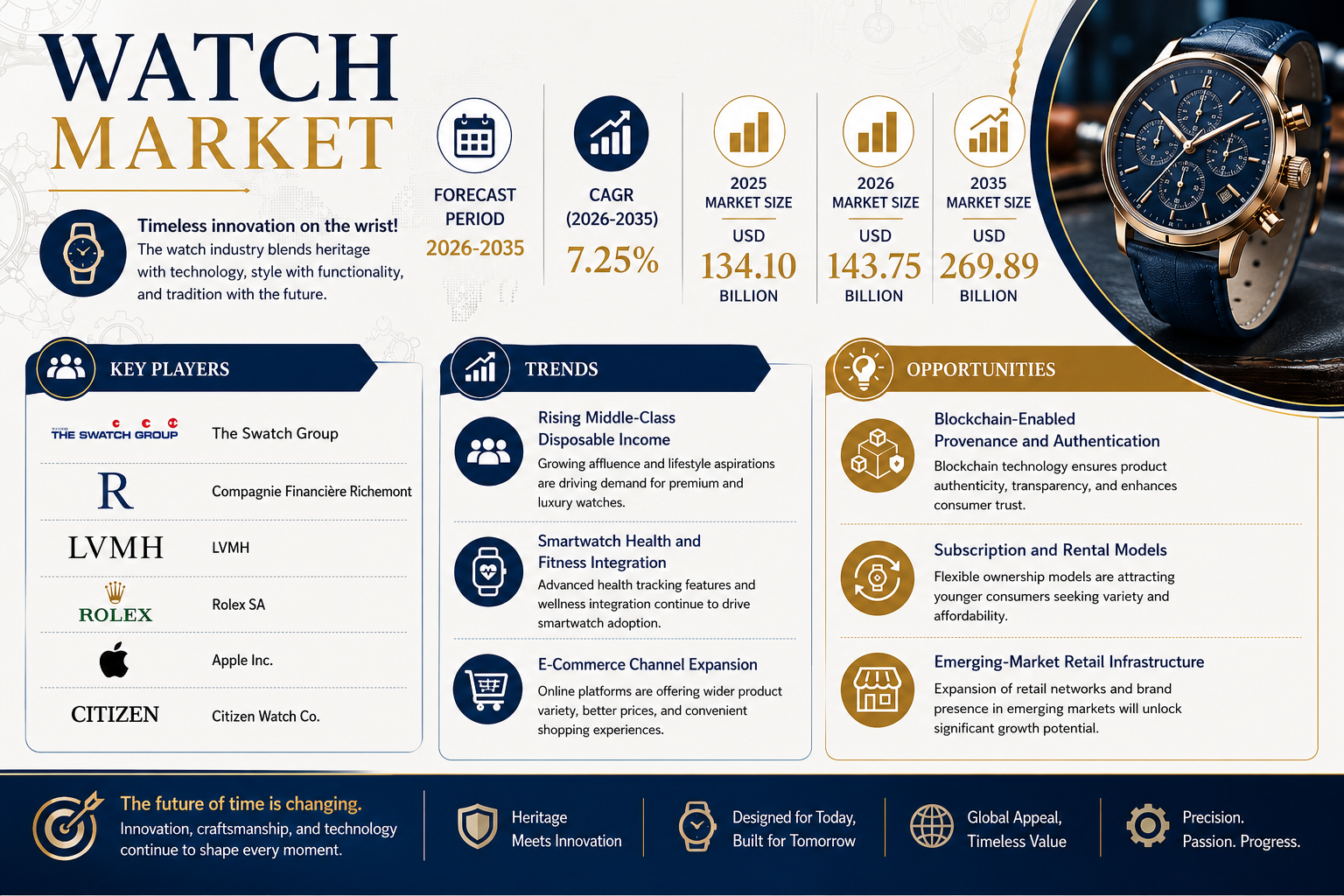
According to Market Research Future analysis, the Watch Market was valued at USD 134.10 Billion in 2025 and is projected to grow from USD 143.75 Billion in 2026 to USD 269.89 Billion by 2035, expanding at a compound annual growth rate (CAGR) of 7.25% during the forecast period of 2026–2035.
The market growth is supported by several factors, including increasing demand for luxury accessories, rising disposable income, growing interest in wearable technology, expansion of e-commerce platforms, and continuous innovation in watch design and functionality. Consumers today are looking for products that combine aesthetics, performance, durability, and advanced features, creating new opportunities for both traditional watchmakers and technology companies.
Market Size and Growth Forecast:
The Watch Market is expected to witness substantial expansion throughout the forecast period as demand increases across both developed and emerging economies. The market valuation is estimated at USD 134.10 Billion in 2025, highlighting the continued relevance of watches as consumer accessories despite competition from smartphones and other digital devices.
The market is expected to reach USD 143.75 Billion in 2026, reflecting steady adoption across multiple consumer categories. By 2035, the industry is projected to achieve a valuation of USD 269.89 Billion, demonstrating strong long-term growth potential.
The projected growth reflects the changing role of watches in modern lifestyles. Traditional watches continue to maintain strong demand due to craftsmanship, heritage value, and emotional appeal, while digital watches and smart wearables are expanding their consumer base through advanced features and connectivity.
Increasing online purchasing behavior is also reshaping market dynamics. The online retail distribution channel is identified as the fastest-growing segment, registering a CAGR of 9.35% during the forecast period. Digital platforms allow consumers to explore a wider variety of brands, compare designs and specifications, access international products, and purchase premium watches conveniently.
Key Growth Factors Driving the Watch Market:
Rising Demand for Luxury and Premium Watches
Luxury watches continue to represent a significant growth opportunity within the global market. Consumers increasingly view premium watches as long-term investments, status symbols, and collectible assets rather than simple accessories. High-quality materials, handcrafted designs, limited-edition collections, and brand heritage are influencing purchasing decisions among affluent consumers.
Luxury watch manufacturers are focusing on exclusive product launches and innovative craftsmanship to attract collectors and high-value customers. The growing popularity of luxury fashion and premium lifestyle products is further supporting demand for high-end watches across global markets.
Expansion of Smart and Digital Watches
Technological advancements have significantly changed the competitive landscape of the watch industry. Smart and digital watches have gained strong acceptance due to their ability to provide health monitoring, fitness tracking, communication features, navigation assistance, and personalized digital experiences.
Consumers are increasingly adopting smart watches as multifunctional devices that support active lifestyles. Features such as heart rate monitoring, activity tracking, sleep analysis, and smartphone integration have expanded the role of watches beyond traditional timekeeping.
Technology companies entering the watch industry have introduced new competition while encouraging traditional brands to explore digital capabilities and connected solutions.
Growth of Online Retail Channels:
The expansion of e-commerce has become one of the most important factors influencing watch sales worldwide. Online retail platforms provide consumers with easy access to domestic and international brands, detailed product information, customer reviews, and personalized recommendations.
The online retail segment is expected to grow at a 9.35% CAGR, making it the fastest-growing distribution channel in the Watch Market. Brands are increasingly investing in digital storefronts, direct-to-consumer strategies, and online marketing campaigns to strengthen customer relationships.
The convenience of online shopping, combined with secure payment options and improved delivery services, is encouraging more consumers to purchase watches digitally.
Request for PDF Sample Copy:
https://www.marketresearchfuture.com/sample_request/8027
Competitive Landscape and Key Players:
The global Watch Market is highly competitive, with participation from traditional watch manufacturers, luxury watchmakers, and technology-focused companies. Market players are continuously adopting strategies such as product innovation, portfolio expansion, digital transformation, and strategic collaborations to strengthen their market presence and address changing consumer expectations.
The major companies operating in the Watch Market include:
▪️Swatch Group
▪️Richemont
▪️LVMH
▪️Rolex
▪️Apple
▪️Citizen
▪️Seiko
▪️Casio
▪️Fossil
▪️and Titan.
Traditional watch brands continue to benefit from their strong heritage, precision craftsmanship, and long-standing consumer trust. Luxury watch manufacturers are focusing on exclusive collections, limited-edition models, premium materials, and personalized experiences to attract collectors and high-income customers. At the same time, technology companies are transforming the industry by introducing smart watches equipped with health tracking, connectivity, and digital capabilities, creating new growth opportunities within the wearable technology segment.
Emerging Trends Shaping the Watch Industry:
Increasing Fusion of Fashion and Technology
One of the major trends influencing the Watch Market is the combination of fashion aesthetics with advanced technology. Modern consumers expect watches to complement their personal style while offering smart features and digital connectivity.
Manufacturers are introducing customizable designs, interchangeable straps, personalized interfaces, and lifestyle-focused collections to meet diverse consumer preferences. This combination of functionality and fashion is attracting younger generations toward watch ownership.
Growing Popularity of Sustainable Watch Manufacturing:
Sustainability is becoming increasingly important within the watch industry. Consumers are showing greater interest in environmentally responsible products, encouraging brands to adopt sustainable materials, ethical sourcing practices, and eco-friendly production methods.
Companies are exploring recycled materials, sustainable packaging, and longer-lasting product designs to align with changing consumer expectations. This trend is particularly influencing premium and luxury watch segments.
Personalization and Customization Demand
Personalized products are gaining attention as consumers seek unique accessories that reflect their personality. Watch brands are responding by offering customized designs, engraving options, limited editions, and personalized features.
Customization is becoming a valuable strategy for brands to create stronger emotional connections with customers and improve brand loyalty.
Market Opportunities:
The Watch Market presents several opportunities as consumer expectations continue to evolve. The integration of advanced technologies into traditional watch designs creates opportunities for brands to develop innovative products targeting different consumer groups.
Emerging economies represent significant growth potential due to rising disposable incomes, expanding middle-class populations, and increasing awareness of international fashion trends. As consumers in these regions become more interested in premium accessories and wearable technology, demand for diverse watch categories is expected to increase.
The rapid growth of digital commerce also provides opportunities for watch manufacturers to reach global customers without depending solely on physical retail networks. Brands that effectively combine online engagement, personalized experiences, and innovative product offerings are expected to gain stronger market positions.
Challenges Impacting Market Growth:
Despite strong growth opportunities, the Watch Market faces several challenges. Competition from smartphones and multifunctional digital devices has reduced demand for watches as essential timekeeping tools. Consumers now expect additional value from watches, increasing pressure on manufacturers to innovate continuously.
Additionally, premium watch brands face challenges related to high production costs, changing consumer preferences, and competition from affordable alternatives. Maintaining brand exclusivity while expanding market reach remains a key challenge for luxury watch manufacturers.
Smartwatch companies also face intense competition as technological advancements continue to accelerate. Continuous investment in research and development is required to introduce improved features and maintain consumer interest.
Market Segmentation:
The Watch Market is segmented based on product type, category, and distribution channel, highlighting the diverse preferences of consumers across different price ranges, functionalities, and purchasing behaviors.
Product Type Outlook:
▪️Quartz Watches: These watches continue to hold strong demand due to their affordability, reliable time accuracy, durability, and minimal maintenance requirements. They are widely preferred by consumers seeking practical and cost-effective timepieces for everyday use.
▪️Mechanical Watches: Mechanical watches remain highly popular among luxury buyers and collectors who appreciate traditional craftsmanship, precision engineering, heritage value, and the intricate artistry involved in watchmaking.
▪️Digital Watches: Digital watches are gaining traction due to their advanced functionality, durability, and user-friendly features. Their integration with modern technology makes them attractive to consumers looking for convenience and multifunctional capabilities.
Category Outlook:
▪️Mass Market Watches: This segment focuses on affordable and accessible watches designed for daily wear. These products attract a broad consumer base by offering practical designs, reliable performance, and competitive pricing.
▪️Premium Watches: Premium watches target consumers seeking luxury, exclusivity, superior craftsmanship, and high-quality materials. These timepieces are often considered fashion statements, collectibles, and symbols of status.
Distribution Channel Outlook:
▪️Offline Retail: Physical retail stores continue to play an important role, particularly in the luxury watch segment. Customers often prefer in-store experiences to evaluate product quality, receive expert guidance, and explore premium collections.
▪️Online Retail: The online retail segment is experiencing rapid expansion and is projected to grow at a 9.35% CAGR. Increasing e-commerce adoption, wider product availability, convenient purchasing options, and digital brand engagement are driving the growth of online watch sales.
Regional Outlook:
The Watch Market demonstrates strong growth opportunities across North America, Europe, Asia-Pacific, and other emerging regions.
North America represents a significant market due to strong demand for smart watches, premium accessories, and technologically advanced wearable devices. High consumer purchasing power and strong adoption of digital lifestyles continue to support market expansion.
Europe remains a major region, particularly for luxury and traditional watches. The region’s strong heritage in watchmaking, premium craftsmanship, and demand for collectible timepieces continue to influence global trends.
Asia-Pacific is expected to experience considerable growth due to rising disposable incomes, expanding middle-class populations, and increasing interest in fashion accessories and smart devices. Countries across the region are becoming important markets for both premium and affordable watch brands.
Latin America and the Middle East & Africa are also witnessing gradual growth as consumers increasingly adopt international brands and premium lifestyle products. Expanding retail networks and improving digital commerce infrastructure are supporting market development in these regions.
Future Outlook:
The future of the Watch Market will be shaped by the combination of tradition, technology, and personalization. While mechanical and luxury watches will continue to maintain their appeal among collectors and premium consumers, smart and digital watches will drive new adoption through advanced functionality.
Companies that successfully balance craftsmanship with innovation will be better positioned to capture future opportunities. Digital retail expansion, sustainable manufacturing, personalized designs, and connected wearable technology will remain key areas influencing industry growth through 2035.
As consumer expectations continue to evolve, watches will increasingly serve as lifestyle devices that combine fashion, health, technology, and personal expression.
Frequently Asked Questions (FAQs)
1. What is the expected size of the Watch Market by 2035?
The global Watch Market is projected to reach USD 269.89 Billion by 2035, growing from USD 143.75 Billion in 2026.
2. What is driving the growth of the Watch Market?
Growth is driven by increasing demand for luxury watches, rising adoption of smart watches, expansion of online retail channels, and growing consumer interest in personalized lifestyle accessories.
3. Which distribution channel is growing fastest in the Watch Market?
The online retail distribution channel is expected to be the fastest-growing segment, registering a CAGR of 9.35% during the forecast period.
4. Which companies are major players in the Watch Market?
Key companies include Swatch Group, Richemont, LVMH, Rolex, Apple, Citizen, Seiko, Casio, Fossil, and Titan.
Read Our Related Research Report:
Luxury Watch Market:
https://www.marketresearchfuture.com/reports/luxury-watch-market-10897
Sports Event Market:
https://www.marketresearchfuture.com/reports/sports-event-market-25261
Art Tourism Market:
https://www.marketresearchfuture.com/reports/art-tourism-market-26343
Sports Event Market:
https://www.marketresearchfuture.com/reports/sports-event-market-25261
3D Printed Wearable Market:
https://www.marketresearchfuture.com/reports/3d-printed-wearable-market-26697
Sagar Kadam
Market Research Future
+1 628-258-0071
email us here
Legal Disclaimer:
EIN Presswire provides this news content “as is” without warranty of any kind. We do not accept any responsibility or liability
for the accuracy, content, images, videos, licenses, completeness, legality, or reliability of the information contained in this
article. If you have any complaints or copyright issues related to this article, kindly contact the author above.

Media gallery