
American Heart Association AI Assessment Lab Report Finds Ultromics’ EchoGo® Heart Failure May Identify HFpEF Earlier Than Standard Care
PR Newswire
OXFORD, England, July 22, 2026
- Powered by retrospective real-world data from Dandelion Health, the American Heart Association’s AI Impact Report provides a third-party evaluation of Ultromics’ EchoGo® Heart Failure
- The independent assessment shows EchoGo® Heart Failure could have identified HFpEF 263 days earlier than standard diagnostic practice, enabling earlier intervention and potentially leading to nearly 500 saved lives per every 10K patients
- The report also projects up to approximately $1.9 million in additional revenue over five years for health systems under the model assumptions described.
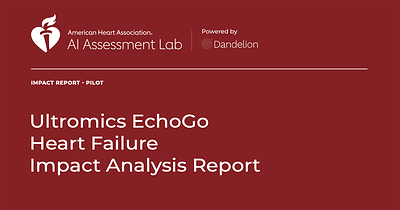
OXFORD, England, July 22, 2026 /PRNewswire/ — Ultromics, a pioneer in AI-driven cardiology solutions, today announced results from an independent clinical data set that shows the company’s EchoGo® Heart Failure AI algorithm could identify patients with heart failure with preserved ejection fraction (HFpEF) up to nine months earlier than standard clinical care, leading to significant potential improvements in patient outcomes and reductions in overall healthcare costs. Intended to help health systems better understand the potential clinical and economic value of cardiovascular and stroke-focused AI, the Impact Report, leverages independent clinical and image data through the American Heart Association AI Assessment Lab, which provides scientifically rigorous evaluations of cardiovascular and stroke AI algorithms. The Assessment Report is based on an independent data set curated by Dandelion Health, a real-world data and clinical AI platform powering next-generation precision medicine and personalized care.
HFpEF is one of the most challenging forms of heart failure to diagnose since symptoms are often nonspecific and may not be detected on standard imaging tests. With normal ranges predominantly derived in white male populations, there is a recognized diagnostic bias leading to an underdiagnosis among women and people of color. An estimated 30–50% of patients are unaware they have a heart failure diagnosis, and many are not identified until the disease has already progressed in severity.
The impact report indicates that EchoGo® Heart Failure could enable earlier identification of HFpEF compared with standard diagnostic practice. The analysis further suggests that this earlier identification could result in lower mortality and healthcare utilizations such as hospital admissions, readmissions, and emergency department visits.
Key findings in the modeled data (per 10K patients over a five-year period) include:
- Earlier detection of HFpEF: EchoGo® Heart Failure could have enabled identification of HFpEF an average of 263 days earlier than standard clinical care among patients who would have otherwise experienced delayed diagnosis.
- Improved survival outcomes: Modeled results suggest early intervention could result in 477 lives saved per 10k patients over a five-year period.
- Potential to reduce disparities in care: Subgroup analyses indicated measurably higher likelihood of benefit among younger and non-white patients.
- Reduced hospital utilization: Earlier identification of HFpEF was associated with meaningful reductions in healthcare utilization, including 406 fewer hospital admissions, 501 fewer readmissions, and 564 fewer emergency department visits.
- Strong economic return: The evaluation finds that health systems can see up to $1.9 million in additional revenue over 5 years when using EchoGo® Heart Failure. Savings were approximately $1,800 per patient from both health system and payer perspectives.
“Since they’re so novel, AI diagnostics are evaluated differently than traditional cardiovascular technologies. Right now, many hospitals struggle to adopt them since they need clear evidence of how these models are trained, validated, and integrated into real clinical workflows before they can trust them in practice,” said Roger Owens, MS, Chief Commercial Officer at Ultromics. “The American Heart Association AI Assessment Lab provides exactly what the field has been missing: clinically meaningful validation, based on independent data, that helps bridge the gap between theory and real-world application. For EchoGo® Heart Failure, that kind of external validation is critical to building institutional trust—demonstrating not only that the model works, but that it works consistently in a diverse data set, can be interpreted alongside physician judgment, and is ready to support decision-making at scale.”
As AI becomes more commonly utilized in healthcare, evaluations like this help show what earlier detection might actually look like in practice. With heart failure affecting millions of people worldwide and often going unrecognized until it becomes severe, identifying HFpEF sooner gives clinicians more time to act, and can help prevent the kind of decline that leads to hospital visits, more serious complications, or even death.
“The American Heart Association AI Assessment Lab provides an independent evaluation and testing environment for clinical AI algorithm performance as well as economic impact, patient outcomes and healthcare workflows,” said Lee H. Schwamm, MD, a stroke neurologist, Heart Association Volunteer Expert, and member of the AHA AI Solutions in Healthcare Steering Committee. “The AI Assessment Lab is guided by an external advisory panel that includes leading experts in AI, cardiology, stroke and healthcare delivery, and enables hospitals to evaluate which AI products will best support the achievement of their patient outcome and economic goals.”
“Large-scale, real-world clinical data is essential to understanding how any diagnostic or assessment performs in practice—regardless of whether it uses blood-based biomarkers or an AI-powered algorithm,” said Shivaani Prakash, MSc, PhD, Chief Data Officer at Dandelion Health. “When algorithms are rigorously and independently tested on diverse, real-world data—and the results are easy for providers to understand—AI developers are incentivized to build better tools, and providers are empowered to adopt the ones that will deliver the most value for their patients. The goal of the American Heart Association AI Assessment Lab, powered by Dandelion Health, is to lead the race to the top in high-quality, high-impact healthcare AI to the benefit of patients and care providers, as well as others in the healthcare system.”
View the full American Heart Association AI Assessment Lab Impact Report.
Disclosure: American Heart Association Ventures has previously invested in Ultromics. The American Heart Association’s AI Assessment Lab operates independently of the Venture Fund and conducts its evaluations in accordance with a standardized, independent assessment methodology.
About Ultromics
Founded out of the University of Oxford, Ultromics is redefining cardiovascular care with FDA-cleared, AI-powered tools that enhance echocardiographic diagnosis. Built in partnership with the NHS and Mayo Clinic, its EchoGo® platform helps clinicians detect complex heart diseases earlier and more accurately—using nothing more than a standard ultrasound scan. Ultromics is backed by leading investors and U.S. healthcare systems and is on a mission to transform how heart disease is diagnosed and treated. For more, visit www.ultromics.com.

 View original content to download multimedia:https://www.prnewswire.com/news-releases/american-heart-association-ai-assessment-lab-report-finds-ultromics-echogo-heart-failure-may-identify-hfpef-earlier-than-standard-care-302831397.html
SOURCE Ultromics


