
Key Takeaways
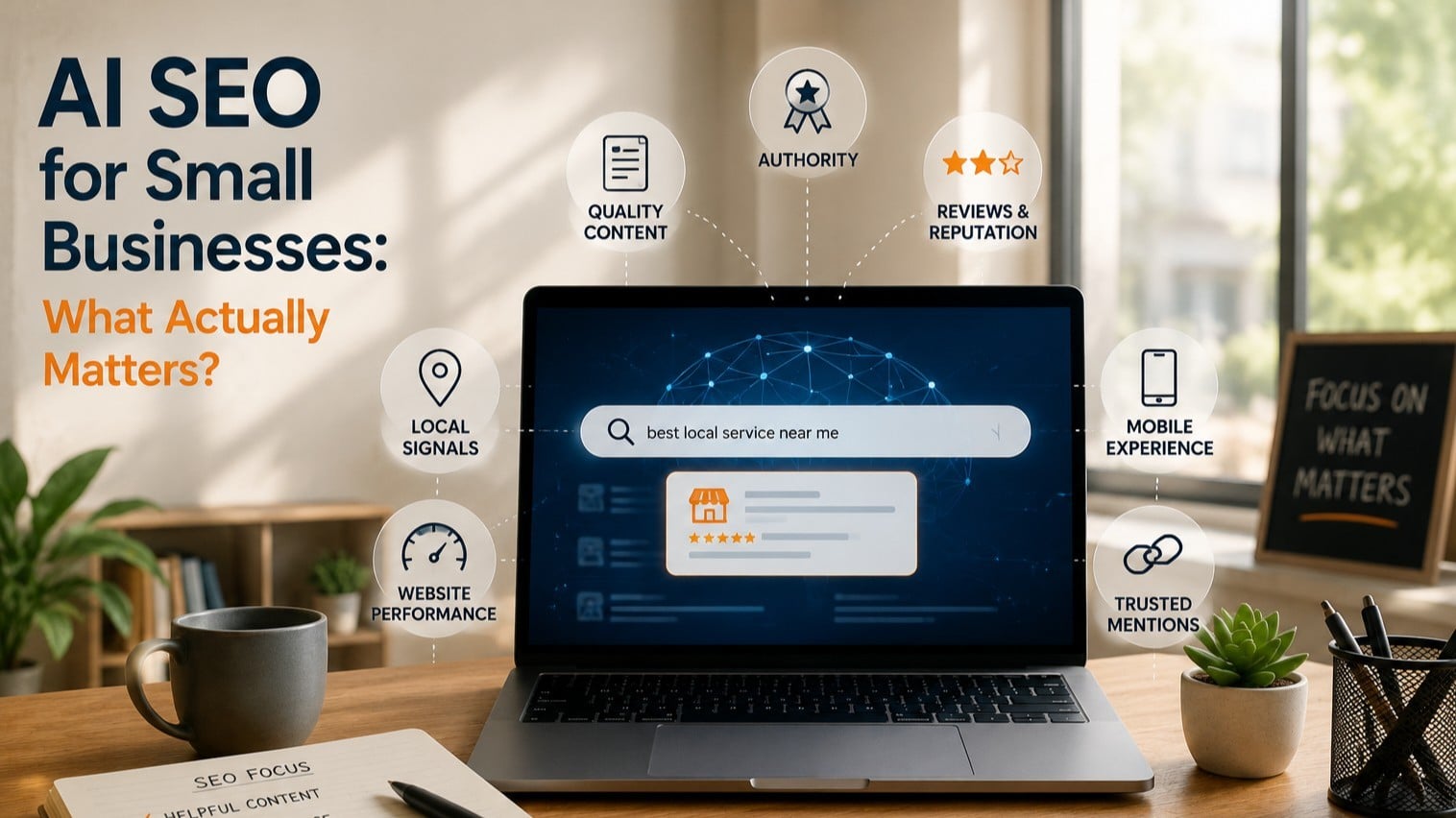
- AI search engines like Google AI Overviews, ChatGPT Search, and Perplexity now sit above traditional blue links – and they cite only one to three businesses per answer, making citation strategy more important than ranking position alone.
- AI tools make SEO execution faster and cheaper, but they don’t replace strategy – human judgment, local expertise, and quality content remain the deciding factors between getting cited and getting ignored.
- Google Business Profile is the single highest-leverage asset for any location-based business, consistently accounting for a large share of local AI citations across studies.
- Thin, AI-generated content published at scale can trigger Google’s scaled content abuse policy – the right approach uses AI to draft and humans to add the expertise that makes content worth citing.
- Most small businesses are still tracking the wrong metrics – AI citation frequency is the number to watch, and there’s a real first-mover advantage for businesses that start monitoring it now.
The SEO playbook that worked in 2022 is only telling half the story in 202. Search has grown a new layer on top – one that doesn’t just rank pages, but picks a handful of businesses to name by name. For small businesses, that shift changes everything about where to focus.
Traditional Rankings No Longer Tell the Whole Story
Ranking on page one used to be the finish line. Today, it’s the entry requirement. As AI platforms handle more queries directly, traditional search volume faces real pressure – and when AI platforms respond to local queries, they typically name just one to three businesses in the entire reply.
That compression is the real disruption. A business can hold a solid position in the traditional local pack and still be completely invisible when someone asks ChatGPT or Perplexity for a recommendation. Rankings haven’t stopped mattering – they’ve just stopped being enough on their own.
AI SEO Is an Execution Upgrade, Not a Magic Button
Most small business owners picture AI SEO as a set-it-and-forget-it system. Plug it in, walk away, watch the rankings climb. That’s not what’s actually happening. AI SEO means using large language models and automation tools to handle the high-volume, repetitive tasks that used to require an entire agency team – keyword clustering, content drafting, schema generation, review responses. The strategy behind those tasks still has to come from a person who understands the business and its customers. A detailed breakdown of what AI SEO actually means for small businesses makes this distinction clear: AI is an execution engine, not a strategist.
A majority of small businesses are already using AI for content marketing and SEO. The ones seeing real results aren’t just producing more content – they’re using AI to work faster on the right things while keeping human judgment in charge of the decisions that matter.
What AI Actually Handles (and What It Doesn’t)
AI tools reliably handle keyword and topic research, content drafting, on-page optimization audits, schema markup generation, Google Business Profile post scheduling, and tracking which pages are getting cited in AI search results. They don’t handle competitive strategy, relationship-based link building, or the local expertise that makes content feel genuine and authoritative. That gap is where most small businesses lose time – investing in tools that produce output that looks right but doesn’t drive results because the strategy was never clearly defined.
The Rankings Race Has a New Layer Above It
Google AI Overviews, ChatGPT Search, and Perplexity all operate similarly: they favor content that is structured, specific, directly answers a question, and carries clear authorship signals. Small businesses are now optimizing for two surfaces at once – traditional blue links and the AI-generated answer layer above them. A business with content that genuinely answers real customer questions with local specificity can win both. Generic blog posts written to fill a content calendar tend to win neither.
Citations Are the New Currency in AI Search
When an AI engine answers a query, it doesn’t display a results page – it picks sources and names them. Being one of those sources is the new definition of winning local search. Businesses that get cited share common traits: structured content, clear authorship, factual depth, and a strong presence in the data sources AI engines pull from. The businesses appearing in those citations aren’t necessarily the ones with the best websites. They’re the ones with the most complete, consistent, and authoritative presence across the signals AI engines use to evaluate trust.
Google Business Profile’s Outsized Role in Local AI Citations
Studies consistently show that Google Business Profile accounts for a dominant share of local AI citations – with some research placing it above 40% and others finding it even higher depending on the AI engine. For a local service business, GBP optimization feeds directly into the AI engines that are increasingly replacing the traditional local pack. Review quantity, recency, response rate, post frequency, photo uploads, and category accuracy all influence whether a business gets pulled into an AI-generated answer.
Where AI Delivers the Fastest Local SEO Wins
Local SEO involves a high volume of repetitive tasks – review responses, GBP posts, citation updates, Q&A entries – that are time-consuming for humans and well-suited for AI to handle at scale. These are the areas where small business owners report the fastest, most measurable improvements.
GBP Automation: Reviews, Posts, and Q&A
Platforms like Merchynt’s ProfilePro use AI to automate the GBP tasks Google’s algorithm explicitly rewards: generating unique, keyword-rich responses to every new review, creating weekly posts with locally relevant content, and populating the Q&A section with questions real customers ask. What used to take four to six hours of manual work per month runs automatically – and the consistency itself is a ranking signal that manually managed profiles rarely achieve.
Schema Markup Without a Developer
Schema markup tells Google exactly what type of content is on a page – and it’s one of the clearest signals AI Overviews use to pull business information. AI assistants and schema generation tools now let a non-technical business owner generate accurate LocalBusiness, FAQ, and Review schema in minutes. Properly implemented LocalBusiness schema that includes service area, hours, and accepted payment types directly improves visibility in both traditional results and AI-generated answer panels – no developer required.
Thin AI Content Is a Real Penalty Risk
AI made content cheap to produce. That’s both the opportunity and the trap. Sites that published large volumes of AI-generated articles with no original insight saw dramatic ranking drops – including losses of 50-80% in some cases – particularly following Google’s scaled content abuse policy updates in 2024 and into 2025. In some cases, sites faced full deindexing.
What Google’s Scaled Content Abuse Policy Actually Targets
Google’s updated guidance is clear: using AI tools to generate many pages without adding value for users may violate its scaled content abuse policy. The target is content produced at scale primarily to manipulate rankings rather than help readers. A 2025 Ahrefs study of 600,000 top-ranking pages found that 86.5% contained some AI-generated content, confirming that AI-assisted content can rank well when it meets quality standards. The policy targets volume without value, not AI assistance itself.
The Human Layer That Separates Cited Content From Noise
The fix is straightforward: AI drafts, humans add. A roofing company that publishes an AI-drafted article about signs a roof needs replacing – and then adds specific observations from their lead contractor about what they actually see on inspections in their region – produces content Google and AI engines will cite. The same article without that human layer is noise. Businesses that connect content to real people through author bios, professional associations, and local citations are consistently more likely to be trusted and named by AI search engines.
What AI SEO Still Can’t Replace
Link Building Stays Human
Backlinks remain one of Google’s strongest ranking signals, and AI has not changed how genuine links are earned. Real links come from real relationships – a mention in a local news article, a listing by a trade association, a reference in an industry roundup. AI can help draft outreach emails faster, but the relationship-building that makes someone want to link to a business is entirely human work. One genuine link from a local newspaper or industry directory carries more weight than fifty links from a mass outreach campaign – and Google’s spam systems have become highly effective at identifying and discounting the latter.
The 4 Metrics That Prove AI SEO Is Working
Most small businesses track the wrong numbers. Domain authority and total keywords ranked look good in reports but don’t connect to customers walking through the door. These four metrics do:
- Google Business Profile Actions: Calls, direction requests, and website clicks directly from the GBP listing. The clearest signal that local SEO is converting to real customer intent.
- Organic Click-Through Rate on Key Pages: Tracked in Google Search Console for highest-value service pages. Rising impressions with flat CTR means title tags and meta descriptions need work.
- Conversion Rate from Organic Traffic: How many visitors from search actually contact, book, or buy? Google Analytics 4 tracks this with goal completions. Traffic without conversion is just noise.
- AI Citation Frequency: How often is the business cited when relevant questions are asked in ChatGPT, Perplexity, or Google AI Overviews? Tools like Profound and Semrush’s AI Toolkit track this – and it’s the metric most small businesses aren’t watching yet, which creates a genuine first-mover advantage for those who start now.
Check these monthly, not daily. A 90-day window is the minimum meaningful period for evaluating whether an AI SEO strategy is actually working. If the numbers aren’t moving after 90 days of consistent execution, the strategy needs to change – not just the tools.
Citations Win – Track Them Before Your Competitors Do
The shift from rankings to citations is already underway. AI search engines are naming businesses by name in response to local queries, and the window of businesses they name is narrow. The good news for small business owners is that the signals driving those citations – a well-managed Google Business Profile, structured and authoritative content, consistent directory presence, and clear authorship – are all achievable without an enterprise budget. AI tools make the execution faster and cheaper than it’s ever been. The strategy, the local expertise, and the decision to start tracking citations before competitors do – that part is still human.
Profit Acuity specializes in helping small businesses build the kind of authority content strategy that gets cited in AI search results – not just ranked in traditional ones.
Profit Acuity
+1 877 624 1229
Concord Drive
Center Valley
PA
18034
United States


